In the world of industrial labeling and automation, you’ll often hear manufacturers claim their systems are “integrated” or “work together seamlessly.” But at ProVision Labels and ProVision Automation by Ahearn & Soper Inc., when we say our solutions are “engineered to work together,” we’re talking about something fundamentally different from simply connecting off-the-shelf components.
True integration goes far deeper than compatibility. It means every element of your labeling system, from the applicator to the printer, from the sensors to the software, has been designed from the ground up to function as a unified whole. Here’s what that really means for your operation.
The Hidden Costs of Piecemeal Solutions
Many manufacturers assemble labeling systems by sourcing components from multiple vendors: a printer from one supplier, an applicator from another, sensors from a third, and software to tie it all together. On paper, this approach might seem cost-effective or flexible. In practice, it often leads to significant challenges.
When components aren’t designed to work together, integration becomes an ongoing project rather than a starting point. You face communication protocols that don’t quite align, timing issues that require constant adjustment, and troubleshooting nightmares when something goes wrong. Which component is causing the problem? The printer? The applicator? The interface between them? Each vendor may point to the other, leaving your production line down while you search for answers.
Precision Through Purposeful Design
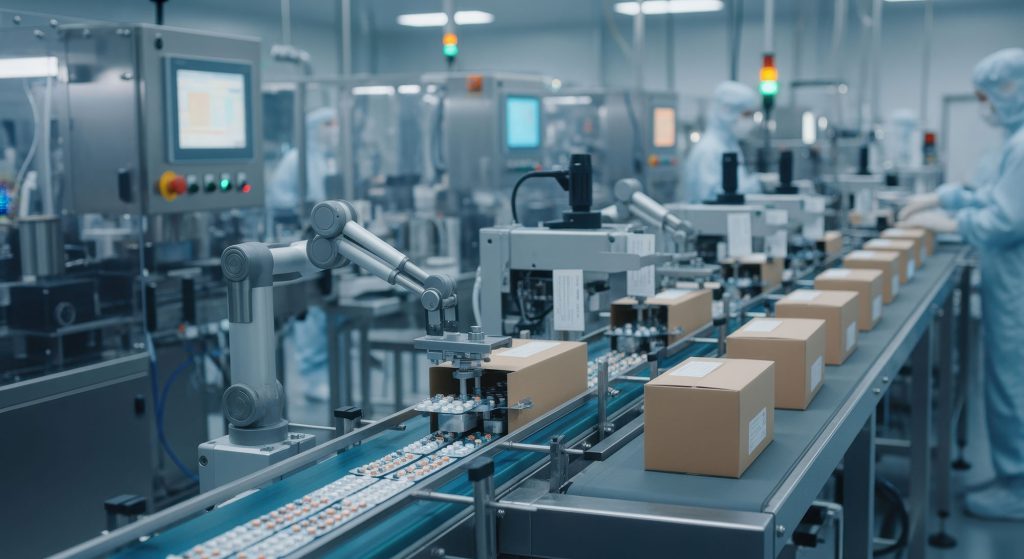
Truly integrated labeling systems deliver precision that piecemeal solutions simply cannot match. When every component is engineered with the others in mind, timing synchronization becomes exact rather than approximate. The applicator knows precisely when the label will be ready. The printer understands the exact speed and positioning requirements of the application process. Sensors communicate in a common language, providing real-time feedback that the entire system can act upon instantaneously.
This precision translates directly to your bottom line. Label placement accuracy improves, often to within fractions of a millimeter. Waste decreases as the system requires fewer test runs and adjustments. Changeovers happen faster because components are designed to reconfigure in harmony rather than requiring individual adjustments to each piece of equipment.
Single-Source Accountability
Perhaps one of the most valuable aspects of genuinely integrated systems is something that becomes apparent only when problems arise: accountability. With a properly integrated solution
from a single provider, there’s no finger-pointing between vendors. One team designed the entire system, one team supports it, and one team is responsible for making it work.
This single-source accountability extends throughout the system’s lifecycle. When you need service, one call connects you with technicians who understand how every component interacts. When you need parts, they’re designed to work together and often share common elements across the system. When you need to expand or upgrade, the path forward is clear because the same engineering philosophy guides every component.
Optimized Communication Architecture
In integrated labeling systems, communication between components isn’t an afterthought, it’s a core design principle. Rather than relying on generic industrial protocols that must accommodate countless different devices, integrated systems can use optimized communication specifically designed for the task at hand.
This means faster response times, more detailed data sharing, and the ability to implement sophisticated control strategies that simply aren’t possible when components must communicate through lowest-common-denominator protocols. Diagnostic information becomes richer and more useful. Predictive maintenance becomes more accurate. Real-time adjustments happen at speeds that make your system more responsive to changing conditions.
Software That Understands Hardware
The integration advantage extends powerfully into the software realm. When the same team develops both hardware and software, the software can leverage detailed knowledge of how the hardware actually functions. It’s not just sending generic commands and hoping for the appropriate response; its orchestrating specific actions based on deep understanding of each component’s capabilities and characteristics.
This enables sophisticated features like automatic parameter adjustment based on label type, intelligent error recovery that knows exactly what went wrong and how to fix it, and user interfaces that reflect how the equipment actually works rather than offering generic controls that might or might not apply to your specific configuration.
Thermal Management and Power Distribution
Less obvious but equally important advantages appear in areas like thermal management and power distribution. When components are designed together, power supplies can be optimized for the actual load characteristics of the entire system. Thermal profiles can be managed holistically, preventing hot spots and ensuring consistent performance across varying production conditions.
These might seem like technical details, but they translate to longer component life, more consistent label quality, and fewer mysterious failures that plague systems cobbled together from disparate parts.
The Upgrade Path Advantage
As your business evolves, truly integrated systems offer clearer, more cost-effective upgrade paths. Because the manufacturer controls the entire ecosystem, they can design backward compatibility into new components and provide coherent upgrade strategies that improve your system without requiring complete replacement.
Compare this to piecemeal systems where upgrading one component might require replacing several others due to compatibility issues, or where new features in one area can’t be leveraged because other components can’t keep up.
Real-World Performance Differences
The theoretical advantages of integration become concrete performance differences in production environments. Integrated systems typically achieve:
Higher uptime percentages because there are fewer points of potential incompatibility and faster diagnosis when issues do occur. Better label quality consistency because timing and positioning are precise throughout the application process. Lower total cost of ownership when you factor in reduced troubleshooting time, faster changeovers, and more efficient service. Greater operational flexibility because the system can be reconfigured as a whole rather than requiring adjustment of multiple independent components.
Beyond the Initial Installation
The value of true integration often becomes most apparent months or years after installation. As operators become familiar with the system, they develop deeper expertise because they’re learning one integrated solution rather than multiple separate systems. As maintenance needs arise, the learning curve is shorter and the parts inventory simpler. As production requirements change, the system can adapt more readily.
Making the Right Choice
When evaluating labeling systems, the question isn’t just whether components can be connected, but whether they were designed to work together from the first sketch on the drawing board. At ProVision Labels and ProVision Automation by Ahearn & Soper Inc., our integrated approach means you’re not just buying equipment, you’re investing in a labeling solution where every element has been engineered with every other element in mind.
This is what “engineered to work together” really means: not compatibility achieved through clever workarounds, but performance optimized through purposeful design. It’s the difference between a collection of parts and a coherent system, between equipment that works and equipment that excels.
When your production demands precision, reliability, and performance, the depth of integration matters. Because in the end, your labeling system is only as strong as the engineering philosophy that brought it together.
 EN
EN  FR
FR