
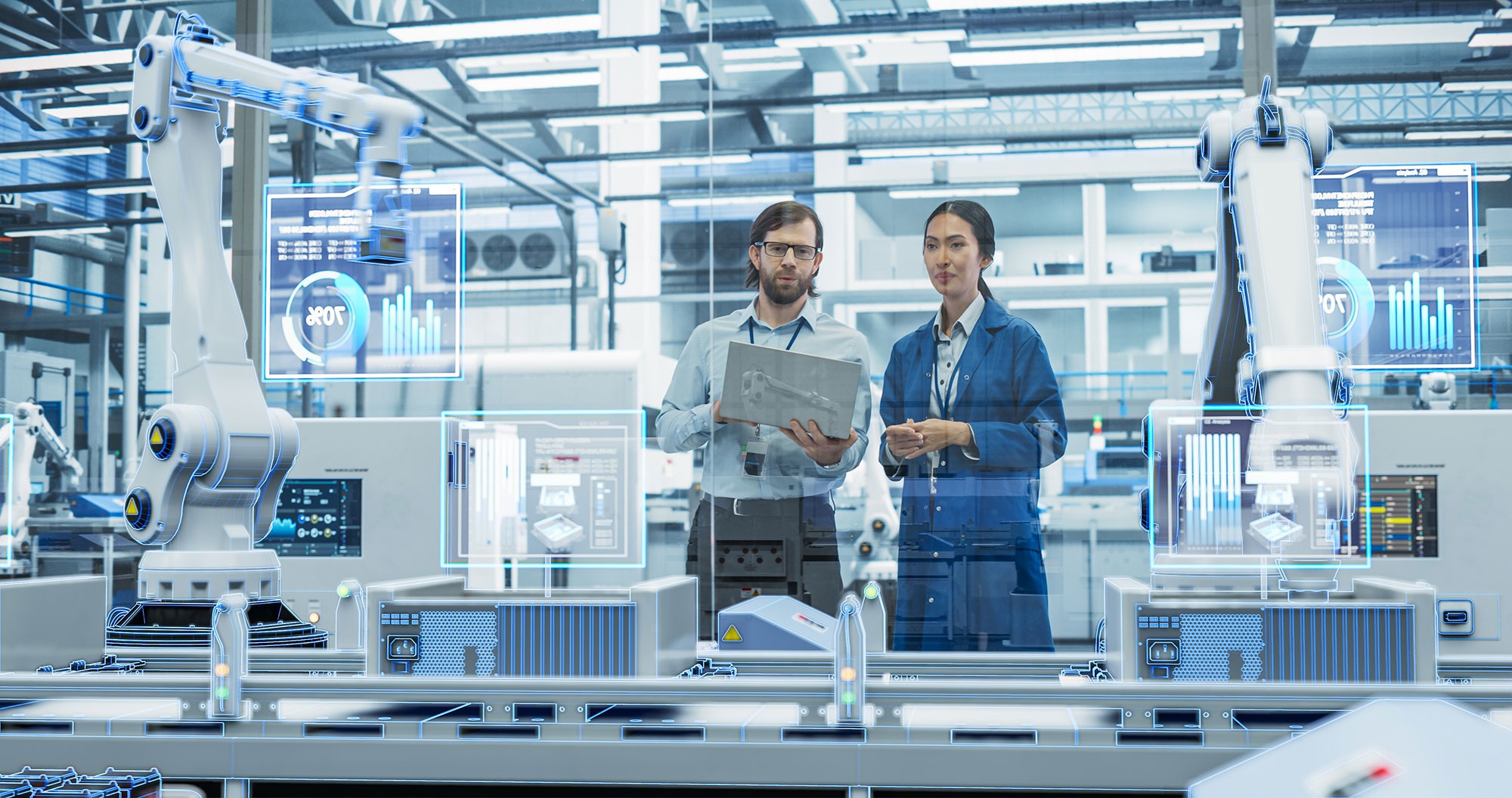
Quality control has long been the backbone of manufacturing excellence. For decades, human inspectors armed with magnifying glasses, calipers, and keen eyes have stood as the last line of defense against defective products reaching customers. But even the most experienced inspectors face inherent limitations: fatigue sets in after hours of repetitive inspection, microscopic defects escape detection, and subjective judgment varies from person to person.
Enter artificial intelligence, specifically computer vision and deep learning, technologies that are fundamentally transforming quality inspection in manufacturing. These AI-powered systems are achieving defect detection rates of 99.9% and higher, identifying flaws invisible to the human eye, and operating with unwavering consistency 24/7. At ProVision Automation by Ahearn & Soper Inc., we’re witnessing firsthand how this technology is revolutionizing production lines across industries.
The Limitations of Human Inspection
Before exploring AI’s capabilities, it’s important to understand why traditional human inspection faces such significant challenges. The average human inspector can maintain peak concentration for about 20-30 minutes before attention begins to wane. Studies show that even highly trained inspectors miss 15-30% of defects during routine quality checks, and this rate increases dramatically when inspecting for microscopic flaws or subtle variations in color, texture, or dimension.
Human vision also has physical constraints. Defects smaller than 0.1mm are extremely difficult to detect without magnification, and inspectors examining thousands of parts per shift inevitably experience eye strain and fatigue. Additionally, subjective interpretation of quality standards leads to inconsistency, what one inspector flags as defective, another might approve, creating quality control variability that impacts the entire production line.
How Computer Vision Outperforms Human Capabilities
Computer vision systems leverage high-resolution cameras, specialized lighting, and machine learning algorithms to inspect products with superhuman precision. These systems can detect defects as small as 0.01mm, ten times smaller than what human eyes can reliably identify. They analyze multiple wavelengths of light, including ultraviolet and infrared spectrums invisible to humans, revealing defects in materials, coatings, and internal structures that would otherwise go unnoticed.
Modern industrial cameras capture images at resolutions exceeding 100 megapixels, processing them in milliseconds. A single AI vision system can inspect hundreds of products per minute while simultaneously checking for dozens of different defect types. This combination of speed, precision, and consistency makes computer vision ideally suited for the demands of modern manufacturing.
Deep Learning: The Brain Behind AI Inspection
While computer vision provides the eyes, deep learning algorithms provide the intelligence that makes AI inspection truly transformative. Unlike traditional machine vision systems that rely on programmed rules, deep learning models learn to identify defects by analyzing thousands or millions of examples.
Convolutional neural networks (CNNs), the most common architecture for visual inspection, can be trained to recognize incredibly subtle patterns. These networks learn hierarchical features, first identifying edges and textures, then shapes and structures, and finally complex defect patterns. This mirrors how human visual processing works, but with far greater consistency and the ability to detect patterns imperceptible to humans.
One of the most powerful aspects of deep learning for quality inspection is its ability to generalize. Once trained on representative defect samples, these systems can identify variations and novel defect presentations they’ve never seen before. They continuously improve as they process more data, adapting to new defect types and production variations without requiring extensive reprogramming.
Real-World Performance: The 99.9% Detection Rate
The 99.9% defect detection rate isn’t just a theoretical benchmark, it’s being achieved in real manufacturing environments across multiple industries. In semiconductor manufacturing, AI vision systems inspect wafers for defects with accuracy rates exceeding 99.95%, identifying contamination, scratches, and pattern irregularities invisible to human inspectors. Automotive manufacturers use AI to inspect welds, paint finishes, and assembled components, catching defects that would lead to recalls if they reached customers.
In pharmaceutical production, computer vision validates pill shape, color, and markings with near-perfect accuracy, ensuring patient safety. Electronics manufacturers employ AI to inspect printed circuit boards, identifying soldering defects, component placement errors, and trace damage with precision that manual inspection cannot match. The textile industry uses AI to detect weaving defects, color inconsistencies, and fabric flaws at production speeds that would require teams of human inspectors to monitor.
These high detection rates translate directly to business value. Reduced defect escape rates mean fewer customer complaints, lower warranty costs, and enhanced brand reputation. Catching defects earlier in production minimizes waste and rework costs. Some manufacturers report quality-related cost reductions of 30-40% after implementing AI inspection systems.
Beyond Detection: AI’s Additional Advantages
AI inspection systems deliver benefits beyond raw detection performance. Their consistency eliminates the subjectivity inherent in human judgment, establishing uniform quality standards across shifts, facilities, and geographic locations. This standardization is particularly valuable for manufacturers with multiple production sites who need to ensure consistent quality globally.
These systems generate comprehensive data that provides unprecedented visibility into production quality. Every inspection creates detailed records, including images, defect classifications, and location data. This information enables manufacturers to identify root causes of defects, optimize processes, and implement predictive maintenance strategies. When AI systems detect patterns indicating equipment drift or material quality issues, production teams can intervene before defect rates escalate.
The speed of AI inspection also enables 100% automated inspection rather than statistical sampling. In industries where safety is paramount, aerospace, medical devices, automotive, this capability to inspect every single product without slowing production is transformative. It eliminates the risk that a defective product slips through simply because it wasn’t included in the sample set.
Implementation Considerations
While AI inspection technology is powerful, successful implementation requires careful planning. Training deep learning models demands high-quality labeled datasets showing both acceptable products and various defect types. For rare defects, generating sufficient training examples can be challenging and may require synthetic data generation or data augmentation techniques.
Integration with existing production lines requires consideration of lighting conditions, camera positioning, product handling, and inspection speed requirements. The computational infrastructure must support real-time processing, which increasingly means deploying edge computing solutions that analyze images directly on the production floor rather than sending data to remote servers.
Human expertise remains essential even with AI inspection. Quality engineers must validate AI decisions, particularly during initial deployment, and establish appropriate thresholds for defect classification. Some manufacturers implement human-in-the-loop systems where AI handles routine inspection but flags borderline cases for human review, combining AI’s consistency with human judgment for edge cases.
The Future of AI-Powered Quality Control
The trajectory of AI inspection technology points toward even more sophisticated capabilities. Multi-modal inspection systems are emerging that combine visual inspection with other sensing technologies, thermal imaging to detect heat distribution anomalies, acoustic sensors to identify unusual sounds indicating mechanical issues, and spectroscopy to analyze material composition. Fusing data from multiple sources creates more comprehensive quality assessments than any single inspection method can provide.
Explainable AI techniques are making inspection systems more transparent, showing not just that a defect was detected but highlighting exactly what the AI identified and why. This transparency builds trust with quality teams and facilitates continuous improvement of inspection processes.
AI inspection is also becoming more adaptive, with systems that can quickly retrain for new products, automatically adjust to production variations, and even predict when products are trending toward defect thresholds before actual failures occur. This shift from reactive inspection to predictive quality control represents the next frontier in manufacturing excellence.
Partnering for Quality Excellence
At ProVision Automation by Ahearn & Soper Inc., we understand that implementing AI inspection technology is not simply about installing cameras and software, it’s about transforming quality control processes to achieve new levels of manufacturing excellence. Our team works closely with manufacturers to assess inspection requirements, design integrated solutions, and deploy AI systems that deliver measurable improvements in defect detection, production efficiency, and product quality.
The transition from human to AI-powered inspection doesn’t eliminate the need for skilled quality professionals; it elevates their role from repetitive visual inspection to data analysis, process optimization, and continuous improvement. By combining human expertise with AI capabilities, manufacturers create quality control systems that are more effective, more consistent, and more responsive than ever before.
As manufacturing continues its digital transformation, AI-powered quality inspection stands as one of the most impactful applications of machine learning technology. The ability to achieve 99.9% defect detection rates while processing products at production speeds isn’t just an incremental improvement, it’s a fundamental advancement that enables manufacturers to deliver consistently superior quality while reducing costs and waste.
The question for manufacturers is no longer whether AI inspection can outperform traditional methods, but rather how quickly they can harness this technology to strengthen their competitive position in an increasingly quality-conscious marketplace.
About ProVision Automation by Ahearn & Soper Inc.
ProVision Automation specializes in delivering advanced automation solutions that transform manufacturing operations. From AI-powered quality inspection to complete production line integration, our team provides the expertise and technology manufacturers need to compete in the modern industrial landscape. Contact us to learn how AI inspection can elevate your quality control processes.
 EN
EN  FR
FR