Cet article est en anglais. La version française est en préparation.
Adhesive chemistry 101: matching labels to application surfaces
Match label adhesive to the surface first: check its surface energy, then the temperatures and service life, then pick acrylic, rubber or silicone.
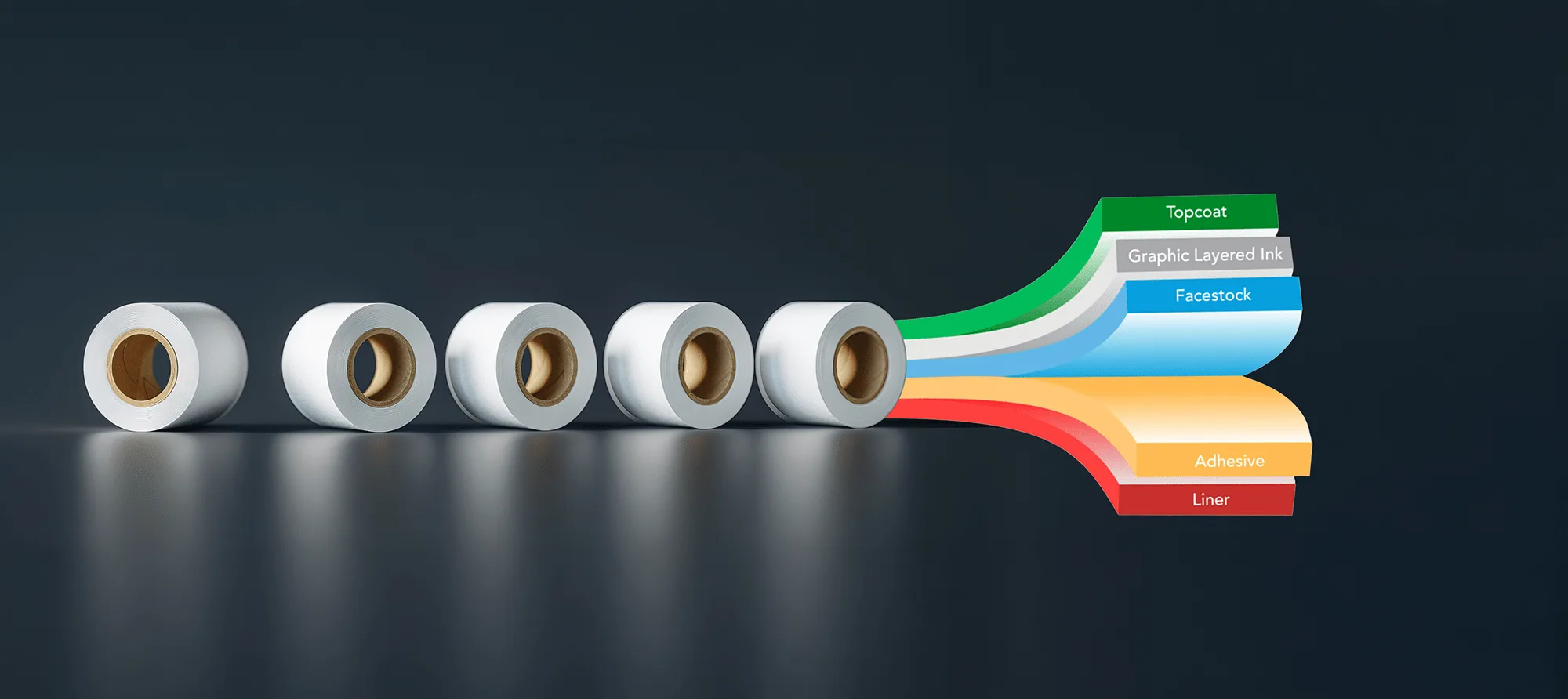
To match a label adhesive to a surface, check three things: what the surface is made of, how hot or cold it gets, and how long the label must last. The surface material decides how well an adhesive can spread and grip. Temperature and service life then point you to an acrylic, rubber or silicone adhesive.
Why the surface matters most
A pressure-sensitive adhesive is a soft, sticky solid. It bonds by flowing into close contact with the surface. This is called wetting out. How well it wets out depends on the surface energy of the material, measured in dynes per centimetre (dynes/cm).
A liquid spreads on a surface when the surface energy is higher than the liquid’s own. Most adhesives sit at about 36 to 39 dynes/cm, according to Avery Dennison. Surfaces well above that are easy to bond. On surfaces below it, the adhesive tends to bead up instead of spread, like water on a freshly waxed car.
Typical surface energy of common materials
3M classes materials below about 36 dynes/cm as low surface energy (LSE). These are typical values from the 3M bonding guide, in dynes/cm:
- Stainless steel: 700 to 1,100
- Aluminium: about 840
- Glass: 250 to 500
- Polyester (PET): about 43
- ABS and polycarbonate: about 42
- Rigid PVC: about 39
- Polyethylene (PE): about 31
- Polypropylene (PP): about 29
- PTFE: about 18
Metals, glass and most engineering plastics are easy to label with a standard permanent acrylic. PE and PP are the usual problem. They need an adhesive made for LSE plastics, or a surface treatment such as corona or flame treatment, which raises the surface energy before labelling.
Powder coat and textured surfaces
Powder coat is not one material. Its surface energy varies a lot with the resin and additives. As 3M points out, the label bonds to the coating, not to the metal under it. Some powder coats are easy to label. Others behave like LSE plastics. Always test on the actual finish.
Texture is a separate issue. A rough or grained surface does not lower surface energy, but it cuts the area the adhesive can touch. A thicker, softer, high-tack adhesive fills the texture better.
Acrylic, rubber or silicone: how they compare
Acrylic adhesives
Acrylics are the most common choice for durable labels. 3M notes that they bond to the widest range of materials and resist ageing well. They also stand up to UV light and many chemicals. The trade-off is time: an acrylic builds full strength more slowly than rubber.
Rubber adhesives
Rubber adhesives (natural or synthetic) give fast, high initial tack at a lower cost. They grip well on LSE plastics, rough corrugated board and less than perfect surfaces. They are weaker against UV, heat and solvents, so they suit shorter-life labels such as carton and shipping labels.
Silicone adhesives
Silicone adhesives handle the widest temperature range. 3M rates them from -40 to over 260°C (-40 to over 500°F). They also stick to silicone surfaces. They cost more and bond less strongly to ordinary surfaces, so they are kept for high-heat jobs.
Service temperature and application temperature
A label data sheet gives two temperatures. The service range is what the label can survive once it has bonded. The minimum application temperature is the coldest surface you can apply it to. These are product specs, not fixed rules for each adhesive family. Here are three examples from Zebra Technologies data sheets:
- Zebra Z-Select 1500D (acrylic): apply at 0°C (32°F) or warmer; service range -20 to 50°C (-4 to 122°F)
- Zebra PolyPro 3000T High-Tack (rubber): apply at -5°C (23°F) or warmer; service range -40 to 70°C (-40 to 158°F)
- Zebra 8000T All-Temp (acrylic): apply at -29°C (-20°F) or warmer; service range -54 to 93°C (-65 to 199°F)
A standard label put on a cold box may never bond, even though it would survive the cold once applied. Use a grade rated for cold application, or label products before they go into cold storage.
Give the adhesive time to bond
Dwell time is how long an adhesive needs to reach full strength. In one application guide, 3M states that at room temperature, a pressure-sensitive adhesive reaches about 50% of final strength after 20 minutes, 90% after 24 hours and 100% after 72 hours. Zebra data sheets allow about 24 hours before the full service range applies.
Firm, even pressure helps the adhesive flow into the surface. So does a clean, dry surface. Dust, oil, moisture and mould release agents all block contact.
How to test a label before you roll it out
- Peel adhesion: PSTC-101 and ASTM D3330 measure the force needed to peel a label away, usually at 180°.
- Shear adhesion: PSTC-107 and ASTM D3654 measure how long a label holds under a steady load parallel to the surface, including at high temperature.
- Field trial: apply labels to real parts on your own line. Then expose them to the heat, cold, water and chemicals they will face.
Lab results on steel test panels let you compare products. They do not replace a trial on your own surface.
Quick selection checklist
- Name the surface material and finish, including any coating or treatment.
- Note the coldest and hottest temperatures, both when applied and in service.
- List exposures such as UV light, water, oils, solvents and cleaners.
- Decide if the label must be permanent or removable, and how long it must last.
- Test samples on real parts before you order in volume.
Frequently asked questions
Why do labels fall off plastic containers?
Many tubs, pails and bottles are made of PE or PP, which have low surface energy (about 29 to 31 dynes/cm). A standard acrylic cannot wet out well on them. Use an adhesive made for LSE plastics, or ask your container supplier about corona-treated parts.
What adhesive works for freezer labels?
Choose a label rated for cold application, not just cold service. Check the minimum application temperature on the data sheet. Some grades, such as Zebra 8000T All-Temp, can be applied as cold as -29°C (-20°F).
How long should a label sit before use?
Most label data sheets call for about 24 hours before the full service range applies. Full bond strength can take up to 72 hours at room temperature.
Which adhesive is best for high heat?
Silicone adhesives handle the most heat, up to over 260°C (500°F). For moderate heat, some acrylic labels are rated to about 93°C (199°F).
ProVision Labels by Ahearn & Soper helps teams choose the right label material and adhesive for their surface and conditions. Talk to our team about the surface you need to label.
Articles you might read next
Three more reads on accuracy, labelling, traceability and the systems underneath them.

Ready to talk about your operation?
Tell us what your warehouse has to do, and we will tell you plainly whether we can help.