Cet article est en anglais. La version française est en préparation.
5 compliance requirements for automotive label durability testing
Automotive labels must pass legal label rules, UL 969, peel adhesion tests, accelerated weathering and the carmaker’s own label specification.
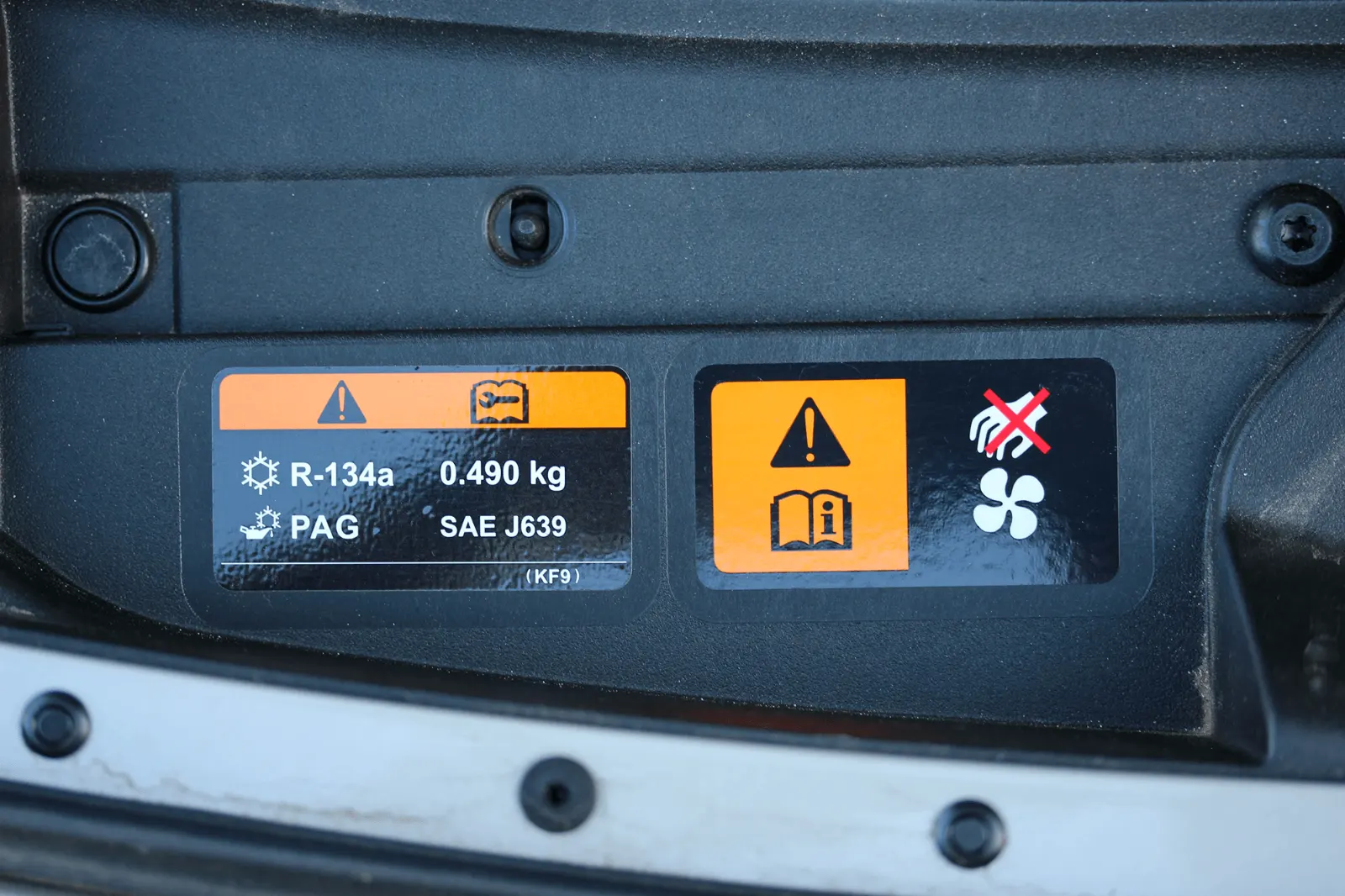
Automotive labels have to pass five kinds of checks: legal rules for required vehicle labels, a label system standard such as UL 969, peel adhesion tests, accelerated weathering, and the carmaker’s own label specification. Together they prove a label stays stuck and readable for the life of the vehicle. If a label fails any one of them, the part can be rejected.
What are the five requirements?
- Legal rules for labels the law requires, such as the vehicle compliance label.
- Label system standards: UL 969 for flat surfaces and UL 969A for labels on cords and hoses.
- Peel adhesion testing, most often to ASTM D3330.
- Accelerated weathering for exterior labels, such as SAE J2527.
- The carmaker’s own label specification, such as GM’s GMW14573.
1. Legal rules for required vehicle labels
Some labels are required by law. In Canada, section 6 of the Motor Vehicle Safety Regulations calls for a compliance label. It shows the maker’s name, the date of manufacture, the national safety mark and the vehicle identification number (VIN). The label goes in a set spot, such as the hinge pillar next to the driver, where it is easy to read.
In the United States, 49 CFR 567.4 says the certification label must be riveted or fixed so that it cannot be removed without destroying or defacing it. That one line drives many durability choices. The face stock, adhesive and print must all hold up, or the label fails the rule.
2. Label system standards: UL 969 and UL 969A
UL 969 covers adhesive labels used as permanent nameplates or markers. It tests the whole label system: the face stock, the adhesive, the ink or ribbon, and any overlaminate. Samples are exposed to heat, cold, water and chemicals, and in some cases UV light. Then they are checked for:
- Legibility of the printed text.
- Adhesion, with no lifting at the edges.
- Curling, wrinkling or shrinkage.
- Resistance to defacement.
UL 969 applies to smooth, flat, rigid surfaces. Labels that wrap around a wire, cable or hose fall under UL 969A, which covers flag labels, flag tags and wrap-around labels. UL 969 is written for devices, appliances and equipment, not vehicles. Many automotive suppliers still use it as proof that a label system is permanent, but the carmaker’s spec has the final say.
3. Peel adhesion testing
Peel adhesion tells you how hard it is to pull a label off a surface. The common method is ASTM D3330, the standard test method for peel adhesion of pressure-sensitive tape. It includes a 180 degree peel and a 90 degree peel.
A good adhesion plan:
- Tests on the real part surface, such as painted metal or textured plastic, not only on a steel test panel.
- Records the surface prep and the time the adhesive had to build before testing.
- Repeats the peel test after heat, humidity or fluid exposure.
Note that ASTM D3359, the cross-cut tape test, is not a label test. It rates how well a coating film sticks to a metal base. It can tell you if the paint under a label is sound, but it does not measure the label’s own adhesion.
4. Accelerated weathering for exterior labels
Exterior labels face sun, rain, road salt and wide swings in temperature. Weathering tests speed up that exposure in a lab. For car exterior materials, SAE J2527 sets a xenon arc test with controlled light, heat and water spray.
You will also see ASTM G155 (xenon arc) and ASTM G154 (fluorescent UV). These are operating practices for the test machines. They do not set test hours or pass marks on their own. The carmaker’s spec or your test plan sets the duration and what counts as a pass, such as colour change, gloss loss or cracking.
5. The carmaker’s own label specification
Each major carmaker has its own rules for labels. GM’s GMW14573, Global Performance Requirements for Labels, sets the requirements for labels on GM vehicles sold around the world. Ford and Stellantis keep their own specs too.
These specs often add test fluids, temperature ranges and approval steps that go beyond general standards. Get the exact spec number and revision from your customer’s drawing or purchase order. A loose term such as “automotive grade” leaves room for a rejected part.
How to build a label test plan
- List every label on the part and the rule or spec that applies to it.
- Test the full label system, not the face stock alone.
- Test on real production surfaces.
- Set written pass and fail criteria before testing starts.
- Ask your label supplier for test reports and material data.
- Retest when a material, adhesive or supplier changes.
- Keep records of specs, test reports and approvals.
Frequently asked questions
Is SAE J2521 a label standard?
No. SAE J2521 is a disc and drum brake dynamometer squeal noise test procedure. It has nothing to do with labels.
Does UL 969 apply to vehicles?
UL 969 is written for labels on devices, appliances and equipment. It is not a vehicle regulation, but it is a common benchmark for label permanence. The carmaker’s spec decides what a vehicle label must pass.
How long should a weathering test run?
There is no single answer. ASTM G154 and G155 do not set test hours. The carmaker’s spec or your agreed test plan sets the hours and the pass criteria.
What makes an automotive label durable?
The right match of face stock, adhesive, print method and overlaminate for the surface and the exposure. These parts must be tested together, because a strong adhesive does not help if the print wears off.
ProVision Labels by Ahearn & Soper makes durable labels for demanding settings. If you need labels that meet an automotive spec, talk to our team about your surfaces, exposure and test requirements.
Articles you might read next
Three more reads on accuracy, labelling, traceability and the systems underneath them.

Ready to talk about your operation?
Tell us what your warehouse has to do, and we will tell you plainly whether we can help.