Cet article est en anglais. La version française est en préparation.
Doctors Caring for Patients While Transforming Healthcare Systems with Zebra Technologies
How Zebra mobile computers, barcode scanners, location tracking, wearables and RFID take admin work off clinicians so they get more time with patients.
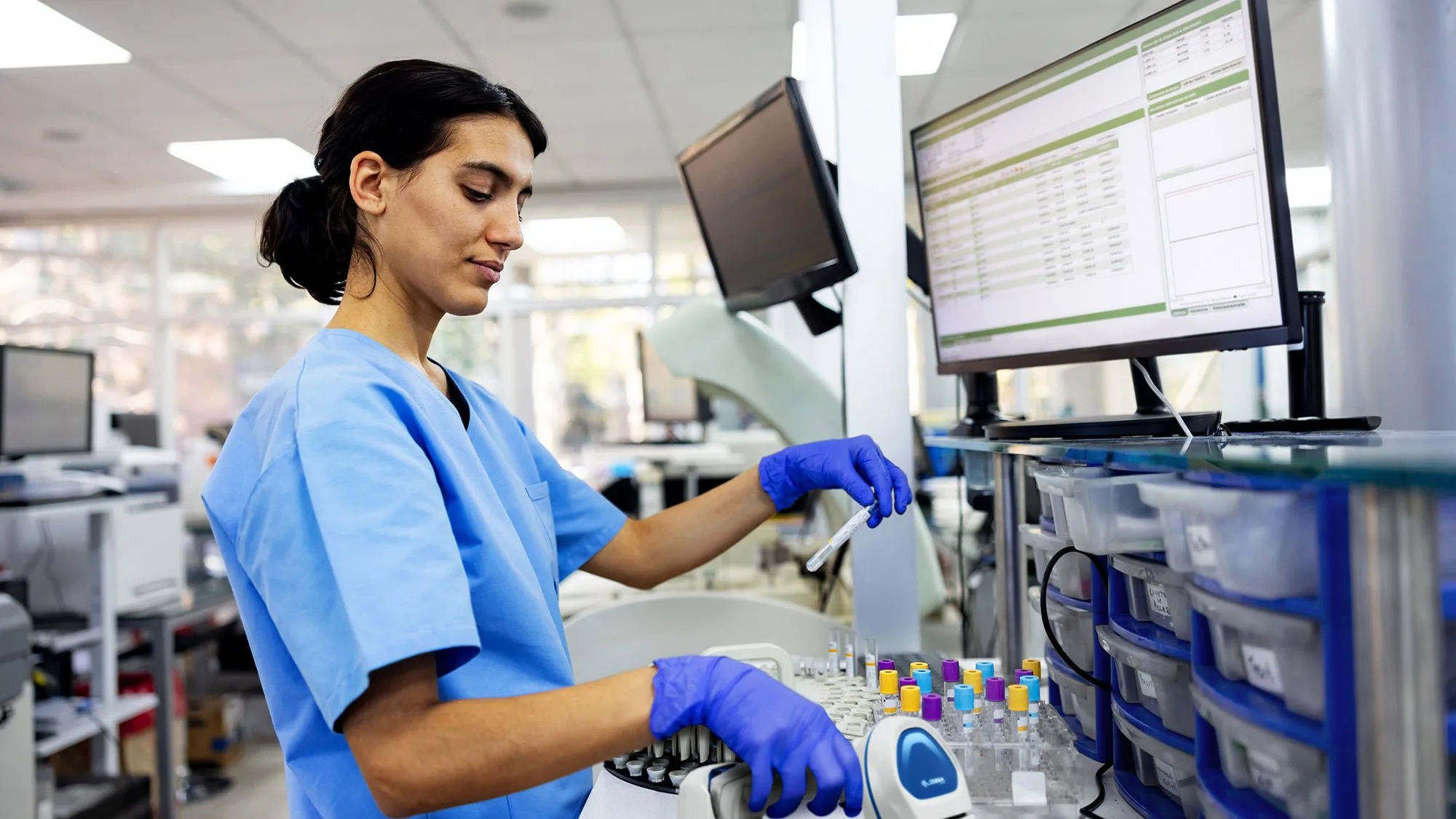
Zebra Technologies helps doctors and nurses spend less time on admin and more time with patients. Its mobile computers, barcode scanners, location tracking, wearables and RFID take the searching, checking and data entry out of clinical work. Ahearn & Soper Inc. puts these tools in place and supports them.
Doctors today face a hard task. They must give caring, personal attention to each patient while working inside complex healthcare systems. The admin load has never been heavier. In one study of physicians in outpatient practice, nearly half the work day went to the electronic health record and desk work [1]. New technology can help restore the balance between caring and admin.
Why do clinicians have less time for patients?
Healthcare workers face a paradox. Medical knowledge and treatment have advanced fast, yet doctors report more burnout and less job satisfaction. The root cause? Staff spend countless hours managing inventory, tracking assets, checking medications and updating patient records. That is time that could be spent at the bedside.
Think about a typical day. In a study of 36 hospitals, nurses walked 1.6 to 8 km (1 to 5 miles) in a 10-hour day shift [2]. In another study of 36 US hospitals and nursing facilities, about 1 in 5 doses was given in error [3]. Patient identification errors still pose serious safety risks. And doctors struggle to get real time patient information when they need it most.
How does Zebra Technologies help healthcare teams?
This is where Zebra Technologies, in partnership with Ahearn & Soper Inc., makes a real difference. Zebra has built a full set of healthcare solutions. They are not designed to replace the human touch. They are designed to support it by removing friction from clinical work.
How do mobile computers help clinicians at the point of care?
Zebra's healthcare mobile computers and tablets are built for clinical settings. They are antimicrobial, ready for disinfectants and made to stand up to 24/7 hospital use. More importantly, they give instant access to electronic health records, lab results and imaging at the point of care. When a doctor does rounds, the full picture is at hand. There is no need to go back to the nurses' station or log into several systems.
How does barcode scanning improve patient safety?
Zebra barcode scanning has become the gold standard for medication administration and patient identification. With scanners like the DS8100 healthcare scanner, nurses can check the "five rights" in seconds: right patient, right drug, right dose, right route and right time. In one US hospital study, barcode scanning with an electronic medication record cut administration errors (other than timing) by 41% and potential adverse drug events by 51% [4]. It protects patients and gives clinicians peace of mind.
What is a real time location system (RTLS) and why use one?
Zebra's Real-Time Location System (RTLS) may be one of its most powerful tools. Hospitals tag key equipment, staff badges and even patients. Then they can find wheelchairs, infusion pumps, ventilators and other assets in an instant. The impact is immediate. Nurses spend less time searching and more time caring. Equipment gets used more, so fewer costly purchases are needed. Patients move through the hospital faster, with shorter waits and higher satisfaction.
How do wearable devices help healthcare staff?
Zebra's wearable devices include ring scanners and wrist-mounted mobile computers. They let healthcare workers stay hands-free while they look up information or scan items. This matters most in operating rooms, labs and medication preparation, where sterility and safety rules come first.
How does RFID help with hospital inventory?
Zebra's radio frequency identification (RFID) technology automates inventory across the hospital. Medications, surgical supplies and key equipment are tracked without manual counts. Stockouts are less likely to get in the way of patient care, and expired items are flagged before anyone uses them. This automation brings real cost savings and safer care.
What results are healthcare organizations seeing?
Healthcare organizations that use Zebra solutions through partners like Ahearn & Soper Inc. are seeing strong results:
- Less documentation time. Scanning replaces typing, so clinicians spend less time on charting and data entry and more on patient care.
- Safer medication. Positive patient ID and barcode checks reduce medication administration errors.
- Better use of equipment. Staff find equipment faster, so more of it is in use. At one hospital, location tracking cut equipment search time by 86.8% [5].
- Better patient outcomes. Faster response, shorter waits and better care coordination.
- A lighter admin load. Less time on routine tasks leaves clinicians more time for the work they trained for.
Why work with Ahearn & Soper Inc.?
Bringing enterprise technology into healthcare takes more than buying equipment. You need a partner who knows both the technology and the demands of healthcare settings. This is where Ahearn & Soper Inc. adds value.
As a trusted Zebra partner, Ahearn & Soper brings:
- Healthcare expertise. A deep understanding of clinical workflows and regulatory requirements.
- Implementation support. Full planning, rollout and training services.
- Ongoing service. Reliable support and maintenance to keep your technology running 24/7.
- Integration. Smooth connections with your existing EMR, pharmacy and clinical systems.
- Custom solutions. Approaches built around your organization's own challenges.
Does this technology replace the human side of care?
No. These tools do not replace the bond between doctor and patient. They strengthen it. They automate routine tasks, end the hunt for information and give instant access to data. In doing so, Zebra's solutions give doctors and nurses back their most valuable resource: time.
Time to sit at a patient's bedside and truly listen. Time to explain a diagnosis and treatment options without rushing. Time to work with colleagues on complex cases. Time to practise medicine the way they hoped to when they joined the profession.
What comes next for healthcare technology?
Healthcare providers, technology makers like Zebra Technologies and implementation experts like Ahearn & Soper Inc. are shaping the future of care together. These tools will keep evolving, with artificial intelligence, predictive analytics and more advanced automation. The goal stays the same: let clinicians focus on what they do best, which is caring for patients.
Healthcare transformation is not about replacing human judgment with machines. It is about removing the barriers between caregivers and the people they serve.
How do you take the next step?
Do you want to reduce clinician burnout, improve patient safety and run more efficiently? Zebra Technologies' proven solutions and Ahearn & Soper Inc.'s implementation skills offer a clear path. The question is not whether to adopt these tools. It is how quickly you can put them to work for clinicians, patients and the future of your healthcare system.
Every minute saved through better technology is another minute a doctor can spend caring for patients. To learn how Zebra Technologies solutions, put in place by Ahearn & Soper Inc., can help your healthcare organization, contact our healthcare solutions team today.
Frequently asked questions
How does barcode scanning help nurses give medication safely?
Scanners like the Zebra DS8100 healthcare scanner let nurses check the five rights of medication administration in seconds: right patient, right drug, right dose, right route and right time.
What can a real time location system track in a hospital?
Hospitals can tag equipment, staff badges and even patients, then find wheelchairs, infusion pumps, ventilators and other assets in an instant.
Do Zebra healthcare tools replace the doctor and patient relationship?
No. They automate routine tasks and give instant access to data, so doctors and nurses get more time to spend with patients.
Sources
- Agency for Healthcare Research and Quality, PSNet summary of Sinsky CA, Colligan L, Li L, and others, "Allocation of Physician Time in Ambulatory Practice: A Time and Motion Study in 4 Specialties", Annals of Internal Medicine, 2016;165(11).
- Hendrich A, Chow MP, Skierczynski BA, Lu Z, "A 36-hospital time and motion study: how do medical-surgical nurses spend their time?", The Permanente Journal, 2008.
- Barker KN, Flynn EA, Pepper GA and others, "Medication errors observed in 36 health care facilities", Archives of Internal Medicine, 2002;162(16):1897 to 1903.
- Poon EG, Keohane CA, Yoon CS and others, "Effect of bar-code technology on the safety of medication administration", New England Journal of Medicine, 2010.
- Huang TL, Lei YF, Wang PC, "Use of wireless geographic locating system to improve medical equipment utilization and medical quality", International Journal for Quality in Health Care, 2025.
Articles you might read next
Three more reads on accuracy, labelling, traceability and the systems underneath them.
Ready to talk about your operation?
Tell us what your warehouse has to do, and we will tell you plainly whether we can help.