Cet article est en anglais. La version française est en préparation.
Barcodes or QR codes: when to choose each label technology
Use a linear barcode to identify items any scanner can read; use a QR code or 2D barcode for more data, phone scans or links.
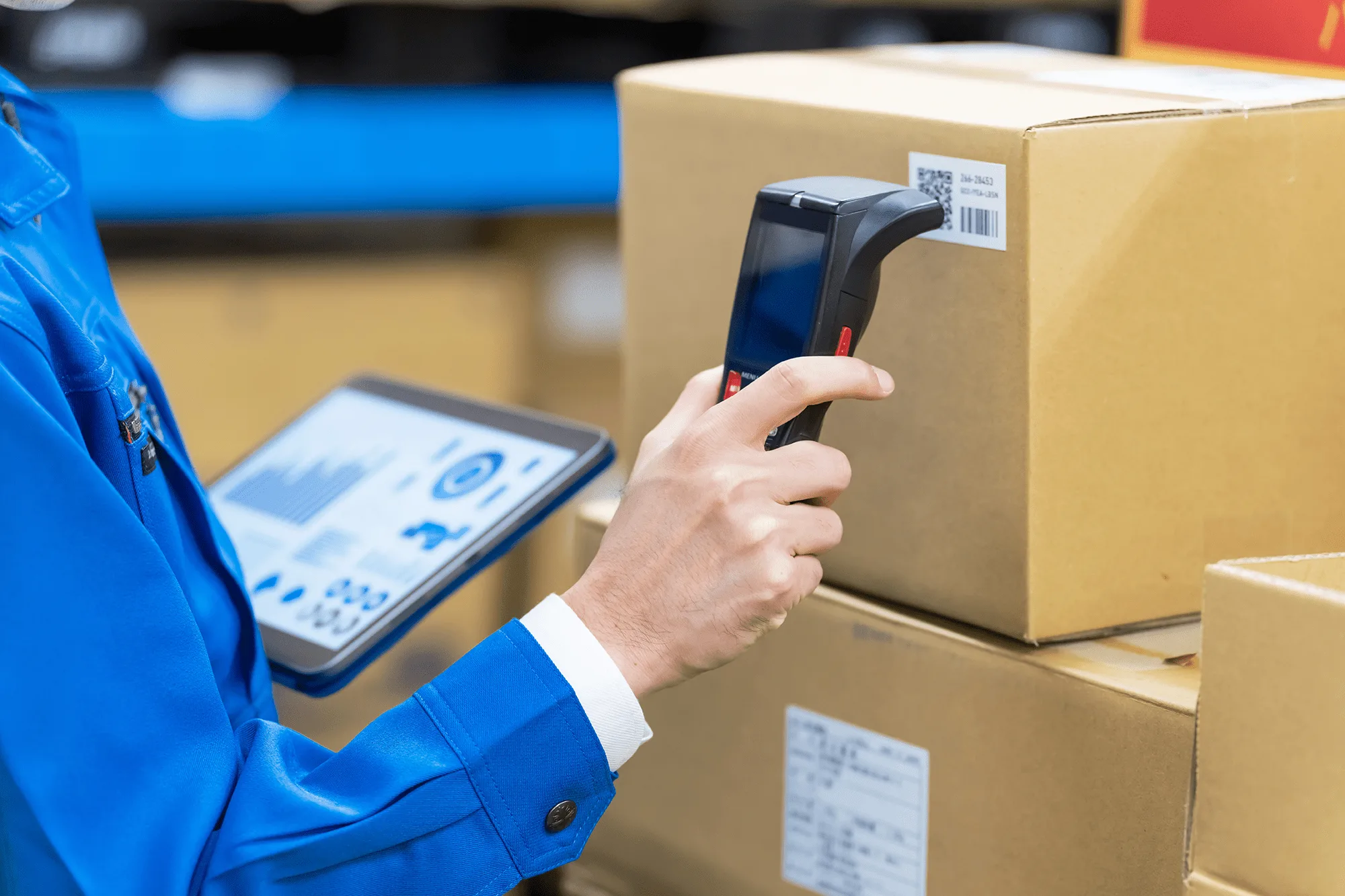
Choose a linear barcode when the label only needs to identify a product, case or location, and every scanner in your chain must read it. Choose a QR code or another 2D barcode when you need to carry more data, such as a lot number, expiry date, serial number or web link, or when people will scan it with a phone. Many labels now carry both.
What is the difference between a barcode and a QR code?
A linear (1D) barcode stores data in a row of bars and spaces of different widths. The UPC-A on North American retail packs holds 12 digits. That number is the Global Trade Item Number (GTIN), the product’s ID in the GS1 system. Linear barcodes have been part of retail since the first UPC scan in 1974.
A QR code is a 2D barcode. It stores data in a square grid of dark and light cells, so it holds data across and down. Denso Wave announced the QR code in 1994. The name means “quick response”, because it was built to be read fast. The auto industry was an early user, putting it on electronic kanban tags to track parts from production to shipping.
How much data can each one hold?
- UPC-A: 12 digits, which is one GTIN.
- Most linear barcodes: about 20 characters, according to Denso Wave. Code 128 can hold more, but the barcode gets wider with every character.
- QR code: up to 7,089 digits, or 4,296 characters in alphanumeric mode (digits, capital letters, the space and a few symbols). That is the largest symbol, version 40, at error correction level L, as listed in the QR code specification summary.
A QR code on a label holds far less than that. More data makes the symbol larger and denser, so it needs sharper print and a closer scan.
When should you use a linear barcode?
- Retail checkout, where UPC and EAN codes are still the code every store can read.
- Shipping, receiving and warehouse labels that must work with the scanners you already own. Older laser scanners read linear barcodes only.
- Simple IDs, such as a SKU, a GTIN, a bin location or a carton number.
When should you use a QR code?
- Links that customers open with a phone camera, such as instructions, warranty details or product pages.
- More data in a small space, such as a GTIN with a lot number, expiry date and serial number on one small label.
- Labels that may get dirty or scuffed, thanks to built-in error correction.
- Fast handling, since a QR code can be read from any direction (360°).
How does QR code error correction work?
A QR code stores extra data so a scanner can rebuild what is missing. You pick one of four levels. Each one sets how much of the code can be lost and still be restored:
- Level L: about 7%
- Level M: about 15%
- Level Q: about 25%
- Level H: about 30%
Denso Wave says level M is the most common choice, and Q or H suit factories where codes get dirty. Higher levels make the code larger. A linear barcode such as UPC-A has only a check digit. It catches a bad read, but it cannot rebuild lost data.
What is changing at the checkout in Canada?
GS1, the standards body behind UPC and EAN, has set a global goal called Ambition 2027. GS1 US calls it Sunrise 2027. By the end of 2027, retail point of sale (POS) systems should read three approved 2D barcodes as well as linear barcodes:
- GS1 DataMatrix
- QR Code with GS1 Digital Link URI
- Data Matrix with GS1 Digital Link URI
GS1 Canada says the shift will be gradual, and products are expected to carry both a 1D and a 2D code during the change. Moving to 2D is optional for brand owners. Stores need image-based scanners to read 2D codes, so sites with older laser scanners will need new hardware.
GS1 Digital Link puts the GTIN inside a web address. One QR code can then ring through at the till and also send a shopper’s phone to product details. A plain marketing QR code that holds only a website address has no GTIN, so the till cannot use it to identify the product.
Where does Data Matrix fit in healthcare?
In healthcare, the 2D code of choice is GS1 DataMatrix, not the QR code. GS1 says GS1 DataMatrix is already widely used in healthcare, and GS1 Digital Link is not used in healthcare barcodes. In Canada, retail and hospital pharmacies set a target of December 31, 2025 to put GS1 DataMatrix on pharmaceuticals. The cannabis sector set January 1, 2025.
How do you choose for your labels?
- Who scans it? A store till, a warehouse scanner or a customer’s phone.
- What data does it carry? An ID only, or also a lot, date or serial number.
- What scanners do you have? Laser scanners read linear codes only. Image-based scanners read both.
- Where will the label live? A clean shelf or a dusty plant floor.
- How will you print it? Every code needs a clear blank margin (the quiet zone) and good contrast. A barcode verifier can grade print quality before you run thousands of labels.
Frequently asked questions
Can a QR code replace a UPC barcode today?
Not for most Canadian retail yet. Retailers are working toward 2D scanning by the end of 2027, and GS1 Canada expects products to carry both codes during the change. A QR code only works at the till if it follows GS1 Digital Link and the store’s scanners can read it.
How much data can a QR code hold?
Up to 7,089 digits or 4,296 alphanumeric characters in the largest version at level L. Codes on labels hold much less, so they stay small and quick to scan.
Which error correction level should I pick?
Level M (15%) is the most common choice. Use Q or H where labels get dirty or scuffed, and allow for a larger code.
Do I need new scanners for 2D barcodes?
You need image-based scanners. Laser scanners read only linear barcodes, so they must be replaced to read QR codes or Data Matrix.
ProVision Labels by Ahearn & Soper designs and prints labels with linear and 2D barcodes, and Ahearn & Soper supplies the image-based scanners and label printers to go with them. Talk to our team about the right code for your products.
Articles you might read next
Three more reads on accuracy, labelling, traceability and the systems underneath them.
Ready to talk about your operation?
Tell us what your warehouse has to do, and we will tell you plainly whether we can help.