
If you’re managing dozens, or even hundreds, of product variations, you know the challenge all too well. Every new flavor, size, scent, or formulation means new labels. New pre-printed inventory to order, store, and hope you’ve estimated correctly. And when that seasonal pumpkin spice variant doesn’t sell as expected? You’re stuck with boxes of obsolete labels gathering dust in your stockroom.
The traditional approach to label management creates a cascade of operational headaches that compound as your product line grows. But there’s a better way forward, and it starts with rethinking how labels are produced in the first place.
The Hidden Costs of Pre-Printed Label Inventory
Most businesses don’t realize how much pre-printed labels are actually costing them until they calculate the full picture. Beyond the per-label printing cost, you’re paying for:
Warehouse space dedicated to storing multiple SKU variations, often in minimum order quantities that far exceed your immediate needs. In facilities where every square foot matters, label storage represents expensive real estate that could be better utilized for actual product inventory.
Cash flow tied up in label inventory that may take months or even years to deplete. Those boxes of labels represent capital that could be invested elsewhere in your business, and minimum order requirements often force you to commit thousands of dollars upfront for each SKU.
Obsolescence and waste when products are reformulated, rebranded, or discontinued. Regulatory changes, ingredient updates, or even simple marketing refreshes can render entire label inventories worthless overnight. For businesses in dynamic industries like food and beverage, cosmetics, or supplements, this waste can amount to tens of thousands of dollars annually.
Coordination complexity across purchasing, inventory management, and production teams just to ensure the right labels are available when needed. Someone must forecast demand, place orders, track shipments, manage storage, and prevent stockouts, all administrative overhead that doesn’t add value to your core business.
How On-Demand Printing Transforms SKU Management
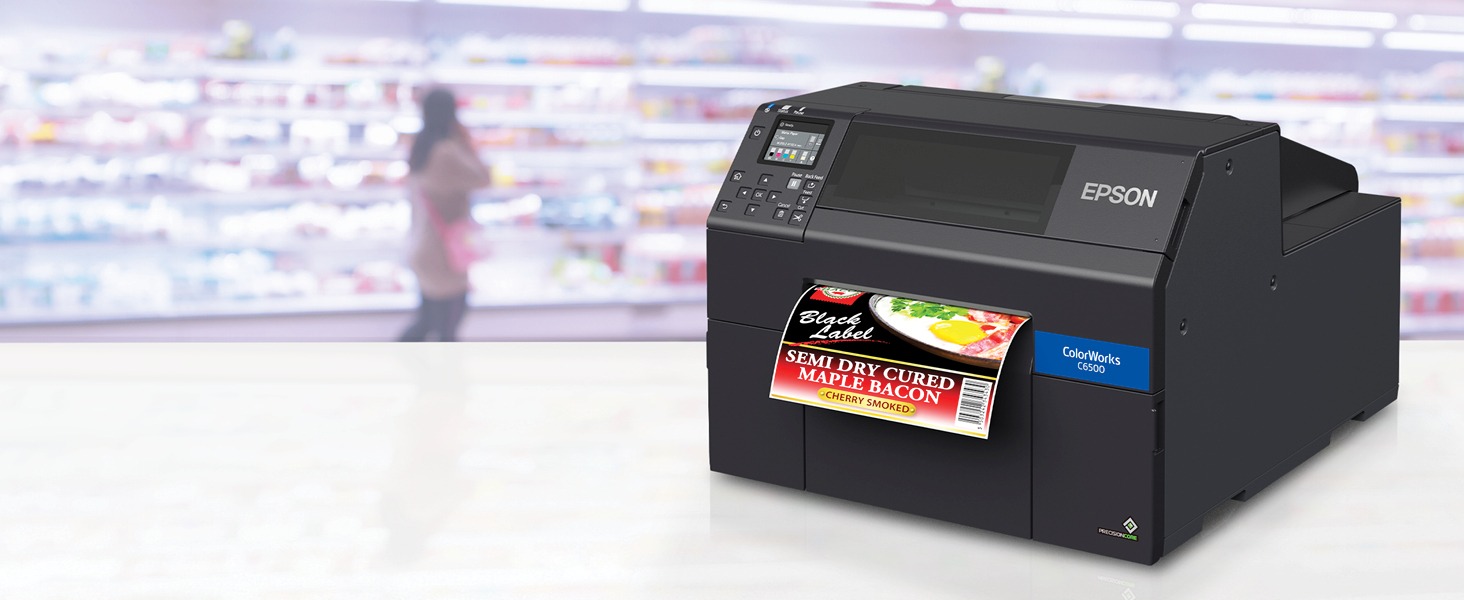
Epson ColorWorks Series label printers fundamentally change the economics and logistics of multi-SKU operations. Instead of managing inventory for every product variation, you manage one thing: blank label stock.
When you need labels for any SKU, you simply print them. No minimum order quantities. No lead times. No wondering if you’ve ordered enough of one variation and too many of another. The printer becomes your in-house label production facility, ready to produce exactly what you need, when you need it.
For a business with 50 SKUs, this might mean replacing 50 different pre-printed label inventories with a single roll of blank material. For a company with 200 variations, the organizational simplification is even more dramatic.
Real-World Scenarios Where On-Demand Printing Shines
Seasonal product launches become dramatically simpler. Instead of committing to large, pre-printed orders for limited-edition items, you can test market response with small batches and scale up only if demand warrants it. Launch a holiday variant with confidence, knowing you won’t be stuck with excess label inventory in January.
Product reformulations and recipe changes no longer trigger waste. When your R&D team tweaks a formulation or your legal team updates allergen information, you simply update your label file and print. The old version doesn’t become worthless inventory; it never existed in the first place.
Custom and private label work becomes economically viable even for small runs. Producing 100 units of a custom product for a retail partner doesn’t require ordering a minimum of 5,000 labels. Print exactly 100 and move on to the next project.
Regional variations and compliance requirements are handled seamlessly. Need French-language labels for Quebec distribution alongside English versions for the rest of North America? Print each as needed, in the quantities required, without maintaining separate inventories of each variation.
The Organizational Benefits Beyond Cost Savings
While the financial advantages are compelling, the organizational improvements often prove even more valuable. Teams spend less time on label logistics and more time on activities that drive business growth.
Your purchasing department simplifies vendor relationships, managing one supplier for blank stock instead of coordinating with an offset printer for every SKU variation. Inventory managers reclaim storage space and reduce the complexity of their tracking systems. Production teams gain flexibility to respond to changing demands without waiting for label shipments.
Perhaps most importantly, you eliminate the anxiety that comes with uncertainty. No more wondering if you ordered enough labels for your best-selling SKUs while watching slow movers gather dust. No more rush fees for expedited label orders when forecasts prove inaccurate. No more difficult conversations about writing off obsolete inventory.
The Epson ColorWorks Series Advantage
Ahearn & Soper Inc. has extensive experience helping businesses implement on-demand label printing solutions using Epson ColorWorks Series printers. These systems are specifically designed for the demands of product labeling, offering industrial reliability, excellent print quality, and the chemical and moisture resistance required for products in challenging environments.
The ColorWorks C6500 series models can handle label widths up to 8 inches, suitable for everything from small cosmetic containers to larger product packaging. Print speeds allow for efficient production runs while maintaining the flexibility to print single labels when needed. The PrecisionCore printhead technology delivers crisp barcodes, vibrant colors, and the professional appearance that your brand requires.
For businesses with even higher volume demands, the ColorWorks Series C8000 handles larger label formats and faster production speeds, while maintaining the fundamental advantage of on-demand printing, producing exactly what you need, when you need it.
Making the Transition
Moving from pre-printed to on-demand label production represents a significant operational change, but it doesn’t have to happen overnight. Many businesses begin by transitioning their most problematic SKUs first, perhaps slow-moving variations where inventory obsolescence is a recurring issue, or frequently reformulated products where label changes are common.
As teams become comfortable with the workflow and see the benefits firsthand, expanding to additional SKUs becomes a natural progression. Within months, what once seemed like a daunting change becomes the new normal, and the old way of managing labels feels unnecessarily complicated in retrospect.
Is Your Business Ready?
If you’re managing multiple product variations and facing any of these challenges, on-demand label printing deserves serious consideration:
- Label inventory regularly becomes obsolete due to reformulations or regulatory changes
- Minimum order quantities force you to commit to more labels than you need
- Warehouse space for label storage is consuming valuable real estate
- New product launches or seasonal items create forecasting uncertainty
- Custom or private label work is limited by label inventory economics
The organizational simplification and operational flexibility that on-demand printing provides can transform how your business manages product variations. Instead of labels dictating your options, your business needs drive label production, exactly as it should be.
Ready to explore how on-demand label printing can simplify your multi-SKU operations? Contact Ahearn & Soper Inc. to discuss your specific requirements and learn how Epson ColorWorks Series printers can eliminate your label inventory challenges. Our team has the expertise to help you transition smoothly and maximize the benefits of on-demand printing for your business.
 FR
FR  EN
EN