
For pharmaceutical manufacturers, FDA/CFIA compliance isn’t optional, it’s the foundation of market access and patient safety. While much attention focuses on drug formulation, clinical trials, and manufacturing practices, label material selection plays a surprisingly significant role in maintaining regulatory compliance. At ProVision Labels by Ahearn & Soper Inc., we help pharmaceutical companies navigate the complex intersection of label materials, FDA/CFIA requirements, and product packaging to ensure that your labels support rather than jeopardize your compliance efforts.
Understanding the Regulatory Landscape
The FDA’s/CFIA’s regulatory framework for pharmaceutical labeling is comprehensive, addressing everything from the content and formatting of label information to the physical properties of the label itself. These requirements appear across multiple regulatory documents, including 21 CFR Part 201 for prescription drugs, 21 CFR Part 801 for medical devices, and various guidance documents addressing specific product categories and emerging technologies.
What surprises many pharmaceutical professionals is that the FDA/CFIA doesn’t explicitly approve or reject specific label materials. Instead, the agency sets performance standards that labels must meet, leaving manufacturers responsible for selecting materials that consistently satisfy these requirements throughout the product’s shelf life and use cycle.
This performance-based approach means that label material selection becomes a critical quality decision requiring careful consideration of how different substrates perform under your specific conditions of use.
Critical Compliance Considerations
Legibility Requirements: The FDA/CFIA mandates that label information must be legible and prominent throughout the product’s lifecycle. This seemingly straightforward requirement has significant material implications. A label material that seems perfectly adequate at the time of packaging may fail to meet legibility standards after six months of refrigerated storage or exposure to typical handling conditions.
Paper labels printed with certain ink systems may experience fading or smudging that renders critical information like lot numbers, expiration dates, or dosage instructions difficult to read. Synthetic materials with appropriate ink or thermal transfer compatibility offer superior resistance to fading, moisture-related degradation, and handling wear that can compromise legibility.
Adhesive Performance and Container Compatibility: Labels must remain securely attached to containers throughout the product’s shelf life and intended use. Adhesive failure presents multiple compliance risks, it can result in product misidentification, loss of critical safety information, and contamination concerns if label fragments contaminate the product or clinical environment.
The FDA/CFIA expects manufacturers to validate that their label adhesive systems perform reliably across anticipated temperature ranges, humidity conditions, and surface types. A paper label with a general-purpose adhesive might adequately adhere to smooth HDPE bottles at room temperature but fail when applied to textured polypropylene containers stored in refrigeration. Synthetic labels can be engineered with specialized adhesives matched to specific container materials and storage conditions.
Direct Product Contact: When labels contact pharmaceutical products directly, such as labels applied to the interior of blister packages or labels on vials where product may contact the label surface—additional considerations arise. Materials must be compatible with the drug product, not leaching harmful substances or interacting chemically in ways that compromise product stability or introduce impurities.
Pharmaceutical manufacturers typically conduct extractables and leachable studies to demonstrate that packaging materials, including labels, don’t introduce harmful substances into drug products. Synthetic materials used in direct contact applications are often selected specifically for their chemical inertness and low extractables profiles. Paper labels, with their complex composition of cellulose fibers, sizing agents, and coatings, present more variables in these studies.
Sterilization Compatibility: For pharmaceutical products requiring terminal sterilization, including certain injectable medications, ophthalmic products, and medical devices, labels must withstand the sterilization process without degradation. Common sterilization methods include autoclaving (steam sterilization), gamma irradiation, ethylene oxide exposure, and electron beam processing.
Paper labels generally cannot survive steam autoclaving, as the combination of heat, pressure, and moisture causes catastrophic failure. Synthetic materials like polyester and certain polypropylene formulations maintain their integrity through autoclave cycles, making them essential for products packaged before sterilization. Similarly, labels exposed to gamma irradiation must resist the yellowing, brittleness, and adhesive degradation that can occur with some materials.
Material Selection for Common Pharmaceutical Applications
Oral Solid Medications: For tablets and capsules in bottles stored at controlled room temperature, both premium paper and synthetic materials can meet FDA/CFIA requirements. The decision often balances cost considerations with operational factors like line speed, labeling equipment compatibility, and the level of handling the product will receive in distribution.
However, when these products face challenging conditions, such as export to high-humidity regions, extended shelf lives, or unit-dose packaging requiring small labels that experience significant handling, synthetic materials provide additional security against compliance risks.
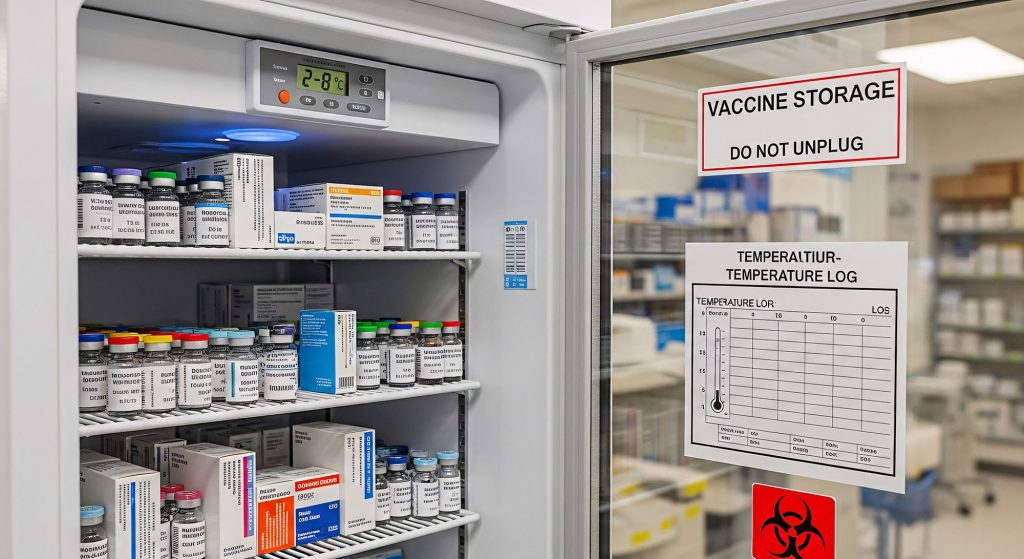
Refrigerated and Frozen Products: Biologics, vaccines, insulin, and other temperature-sensitive pharmaceuticals require synthetic label materials almost without exception. The condensation that forms on containers removed from refrigeration, the low-temperature brittleness that can affect some materials, and the adhesive challenges at cold temperatures make synthetic materials the reliable choice for cold chain products.
A major vaccine manufacturer learned this lesson when paper labels on refrigerated products experienced adhesive failure during a distribution chain quality audit. The resulting investigation, product holds, and re-labeling costs far exceeded any savings from using economy label materials.
Injectable Medications: Vials, ampoules, and prefilled syringes present unique labeling challenges. Labels often occupy limited real estate on small containers, requiring materials that accept small text and detailed graphics clearly. Many injectable medications undergo autoclave sterilization after filling and labeling, demanding materials that survive this process.
Synthetic labels excel in these applications, offering the clarity needed for small-format printing, the durability to withstand sterilization, and the moisture resistance to maintain legibility when vials are stored in refrigeration or ice baths before administration.
Clinical Trial Materials: Investigational drugs face heightened regulatory scrutiny, including requirements for blinding, randomization coding, and meticulous documentation. Label materials for clinical trials must maintain legibility for the entire study duration, which may extend several years for long-term safety studies.
Synthetic materials provide the longevity needed for extended clinical trials while supporting the specialized printing requirements for randomization codes, patient identification, and multi-language information often required in international trials.
Documentation and Validation
The FDA/CFIA expects pharmaceutical manufacturers to document their label material selection decisions and validate that chosen materials perform as intended. This includes stability studies demonstrating that labels remain legible and securely attached under accelerated and long-term storage conditions matching the product’s labeled storage requirements.
ProVision Labels supports these validation efforts by providing technical data sheets specifying material properties, adhesive characteristics, temperature performance ranges, and chemical resistance profiles. We can also supply representative samples for inclusion in stability protocols and compatibility studies.
When working with synthetic materials, documentation should address the specific polymer composition, any coatings or treatments applied, adhesive chemistry, and relevant industry certifications. For materials in direct product contact, additional documentation regarding extractables potential and regulatory suitability may be required.
Navigating Material Changes
Changing label materials after initial product approval requires careful consideration of FDA/CFIA notification requirements. For some changes, manufacturers can implement them under change-being-effected or annual report protocols. Other changes may require prior approval supplements, particularly if the change affects label legibility, critical safety information, or involves moving to a completely different material class.
Before changing label materials, whether for cost reduction, supply chain reasons, or performance improvement, consult with regulatory affairs professionals to determine notification requirements and ensure that validation studies support the change.
Futureproofing Your Label Strategy
The pharmaceutical regulatory landscape continues evolving, with increasing emphasis on serialization, track-and-trace capabilities, and digital integration. When selecting label materials today, consider how they will accommodate future requirements.
Synthetic materials typically offer superior performance for variable data printing used in serialization, better support for RFID integration, and more reliable barcode scanning across the product lifecycle. These capabilities position manufacturers to meet emerging regulatory requirements without needing wholesale changes to labeling infrastructure.
Conclusion
FDA/CFIA compliance in pharmaceutical labeling extends far beyond ensuring accurate content and proper formatting. The physical label material itself plays a critical role in maintaining compliance by ensuring that information remains legible, labels stay attached, and materials perform reliably under intended conditions of use.
At ProVision Labels by Ahearn & Soper Inc., we bring deep expertise in pharmaceutical labeling requirements to help you select materials that support your compliance objectives. Whether you’re launching a new product, addressing label performance issues, or planning for future regulatory requirements, we can guide you through the material selection process with confidence.
Regulatory compliance starts with the right materials. Let us help you make selections that keep your products compliant and your patients safe.Contact ProVision Labels to discuss your pharmaceutical labeling compliance needs and access our technical resources for regulatory documentation.
 FR
FR  EN
EN